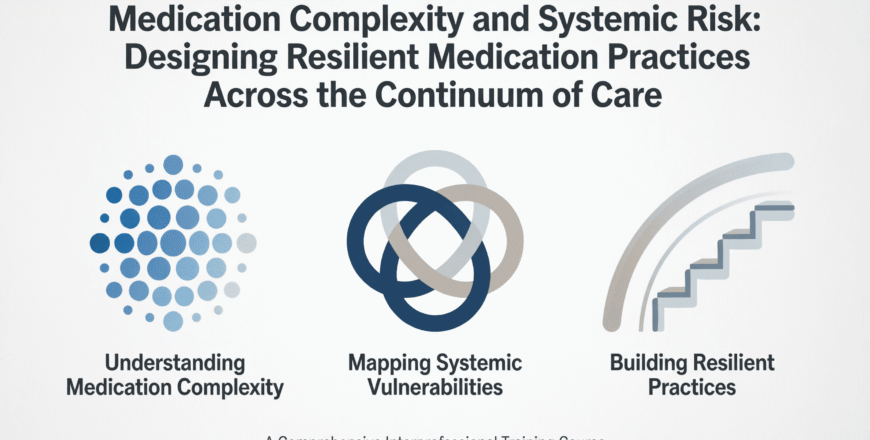

Medication Complexity and Systemic Risk

- Description
- Curriculum
- Reviews
• Understand how complexity in medication processes increases systemic risk.
• Identify failure points in the medication-use process across settings.
• Explore the role of all healthcare professionals in medication safety, not just prescribers.
• Apply systems thinking to improve medication-related workflows.
• Implement best practices for medication reconciliation, handoffs, and communication.
• Design resilient practices that mitigate human error and enhance reliability.
• Analyze high-risk medications and how to manage them across transitions.
• Develop team strategies for ongoing monitoring and improvement of medication safety.
-
1
 1-Medication Complexity
This lesson provides a sobering overview of the medication safety crisis, highlighting the significant scope and impact of medication errors as a major public health problem. It presents alarming statistics, including that errors occur in approximately 1 in 5 hospital doses and 1 in 3 ambulatory prescriptions, leading to an estimated 125,000 deaths and 2.2 million injuries annually in the United States. The lesson emphasizes that most medication errors are preventable and often result from system failures rather than individual mistakes, underscoring the importance of implementing robust systems and processes to prevent errors. It also addresses the substantial economic burden, with preventable adverse drug events costing around $17 billion annually in direct medical costs, not to mention even higher indirect costs from lost productivity. Finally, the lesson stresses that medication safety is a shared responsibility among all healthcare professionals—physicians, nurses, pharmacists, and patients—each playing a critical role in prevention.
-
2
 Quiz 1
 -
3
2-Medication Errors
This lesson provides a foundational overview of medication errors in healthcare. It defines a medication error as any preventable event that may lead to inappropriate medication use or patient harm. The lesson covers the main categories of errors—including prescribing, dispensing, administration, monitoring, and patient education—and explores their root causes, such as action failures, omissions, communication breakdowns, and calculation mistakes. It also classifies errors by severity, ranging from no harm to serious adverse events, and by type, such as wrong patient, wrong drug, or wrong dose. Importantly, the lesson emphasizes that not all errors cause harm, but every error signals a system failure that requires investigation and improvement to enhance patient safety.
-
4
Quiz 2
-
5
3-Non-Prescribers Collaboration
This lesson highlights the critical role of interdisciplinary collaboration in ensuring medication safety. It emphasizes that pharmacists, nurses, physicians, and other healthcare professionals each bring unique expertise to the table, and working together improves patient outcomes. The lesson outlines the specific contributions of each team member—nurses in verification and administration, pharmacists in providing expert recommendations, and physicians in prescribing—while also acknowledging the valuable input of patients, families, and diagnostic services. Key enablers of effective collaboration include structured communication, psychological safety, mutual respect, and regular forums like interdisciplinary rounds and medication safety committees. Finally, the lesson stresses that organizations must invest in interprofessional education, break down hierarchical barriers, and foster a collaborative culture, as this teamwork is a hallmark of high-performing healthcare systems dedicated to patient safety.
-
6
Quiz 3
-
7
4-Handovers Transitions
This lesson addresses the critical issue of handover problems in healthcare and their impact on medication safety. It defines handovers as the transfer of patient care responsibility between professionals or teams, identifying them as high-risk points where medication errors commonly occur due to lost, inaccurate, or incomplete information. The lesson outlines various handover settings, including shift changes, inter-unit or inter-hospital transfers, admissions, discharges, and transfers to or from intensive care. It highlights common failures such as omitted or duplicated medications, uncommunicated changes, missed allergies, and overlooked patient-specific factors. The lesson stresses that these breakdowns can lead to serious harm, including adverse drug events, therapeutic failures, and even death. Ultimately, it underscores that improving handover processes is essential for enhancing patient safety and reducing medication-related risks.
-
8
Quiz 4
-
9
5-Polypharmacy Deprescribing
This lesson provides an overview of polypharmacy—the concurrent use of multiple medications—and its implications for patient safety. It defines polypharmacy, commonly as the use of five or more medications, and notes its increasing prevalence, especially among elderly patients who may take ten or more drugs. The lesson clarifies that polypharmacy is not inherently problematic, as many patients need multiple medications to manage chronic conditions. However, it significantly raises the risks of medication errors, drug interactions, adverse effects, and other medication-related problems. The concept of inappropriate polypharmacy is introduced, where medications are unnecessary, duplicative, or contraindicated, leading to poor outcomes and higher costs. The lesson concludes by emphasizing the importance of regular medication reviews to ensure that every prescribed drug provides benefit that outweighs its risks, promoting safer and more rational prescribing practices.
-
10
Quiz 5
-
11
6-Reconciliation High Risk
This lesson introduces medication reconciliation as a vital patient safety practice aimed at preventing medication errors during care transitions. It defines the process as comparing medication lists at critical transition points—such as hospital admission, discharge, unit transfers, and emergency department visits—to identify and resolve discrepancies. The lesson outlines the key steps involved: obtaining an accurate medication history, creating a current medication list, comparing it with new orders, identifying any additions, removals, or changes, resolving discrepancies through collaboration, and documenting the entire process. It emphasizes that medication reconciliation is a shared responsibility among physicians, nurses, pharmacists, and patients, with each contributor offering unique insights to ensure accuracy. Ultimately, the lesson underscores that this practice is essential for maintaining continuity of care, reducing errors, and improving patient outcomes across all healthcare settings.
-
12
Quiz 6
-
13
7-Workflows Systems
This lesson focuses on standardization as a foundational strategy for improving medication safety. It defines standardization as the process of establishing and implementing consistent procedures and practices across an organization to reduce variability—a major source of medication errors. When processes are not standardized, different staff may perform the same task in different ways, increasing the risk of mistakes. The lesson covers key areas where standardization applies, including medication ordering, dispensing, administration, monitoring, communication, and documentation. It emphasizes that standardized processes should be grounded in evidence and best practices, clearly documented, communicated to all staff, and supported by proper training. Additionally, the lesson highlights the importance of monitoring compliance and effectiveness to ensure that standardization truly enhances safety and reduces errors across the healthcare system.
-
14
Quiz 7
-
15
8-Resilience Weak Signals
This lesson introduces resilience engineering as an approach to designing healthcare systems that can adapt to challenges and maintain safety even when unexpected problems arise. It distinguishes resilience from reliability—while reliability ensures systems work as designed, resilience ensures they can adapt when things go wrong. The lesson outlines key characteristics of resilient systems, including flexibility, redundancy, diversity of approaches, awareness of potential problems, and the ability to learn and improve. In the context of medication safety, resilience means having systems that remain safe despite staff fatigue or distraction, adapt to new medications or processes, respond to emerging issues, and learn from errors and near-misses. The lesson concludes by emphasizing that building resilience requires understanding real-world work practices, involving frontline staff in system design, creating flexible processes, providing adequate tools and information, and supporting continuous learning to strengthen safety culture.
-
16
Quiz 8
-
17
9-Communication Monitoring
This lesson emphasizes the critical role of structured communication in enhancing medication safety within healthcare teams. It identifies poor communication as a major cause of medication errors and introduces structured tools and techniques to improve information transfer. Key tools covered include SBAR (Situation, Background, Assessment, Recommendation) for communicating critical information clearly and concisely, handoff protocols to standardize information exchange during care transitions (such as shift changes, unit transfers, and hospital discharges), and read-back procedures to verify that information, especially medication orders, has been accurately understood. The lesson also highlights the importance of using standardized terminology—avoiding ambiguous abbreviations—and maintaining clear documentation to ensure that all team members have access to accurate and complete information. Overall, the lesson underscores that structured communication reduces variability, prevents misunderstandings, and is fundamental to reducing medication errors and improving patient outcomes.
-
18
Quiz 9
-
19
10-Design Thinking
This lesson introduces design thinking as a human-centered approach to problem-solving, with practical applications in healthcare and medication safety. It outlines the five-phase process: Empathize—understanding user needs, frustrations, and perspectives through interviews and observations; Define—clearly articulating the root problem based on user insights; Ideate—generating a wide range of creative solutions without judgment; Prototype—creating mockups or simulations, from low-fidelity sketches to high-fidelity models, to test ideas; and Test—evaluating prototypes with users, gathering feedback, and iterating until the solution effectively meets user needs. The lesson emphasizes empathy, creativity, and iterative refinement, highlighting how this approach can uncover innovative solutions to complex medication safety challenges by keeping patients and healthcare professionals at the center of the design process.
-
20
Quiz 10
-
21
11-Technology Innovation
This lesson explores the role of technology in the future of medication safety, building upon current systems such as EHRs, CPOE, BCMA, and smart pumps—which have improved safety but come with limitations. It looks ahead to emerging technologies, including artificial intelligence and machine learning for predictive analytics and personalized decision support, pharmacogenomics for precision medicine, blockchain for supply chain security, and the Internet of Medical Things for continuous remote monitoring. The lesson also highlights digital therapeutics, mobile health, voice-activated systems, and VR training as tools to enhance medication management and learning. It envisions an integrated ecosystem of technologies that enables better medication selection, dosing, monitoring, and error prevention. However, the lesson stresses that technology alone is not sufficient—success depends on good system design, proper implementation, staff training, leadership support, a strong safety culture, and attention to human factors. It concludes by emphasizing the need for integration, standardization, regulatory support, patient and provider engagement, and a focus on equity and continuous improvement to realize the full potential of technology in advancing medication safety.
-
22
Quiz 11